
Introduction
You finally graduate.
After years of lectures, assignments, examinations, and project work, you receive your degree. Family members celebrate. Friends congratulate you. You begin applying for jobs with excitement, believing that university has prepared you for the professional world.
Then your first job arrives.
Within a few weeks, reality feels very different.
You struggle to communicate confidently during meetings.
Managing multiple tasks feels overwhelming.
You are unsure how to write professional emails.
Receiving feedback feels personal.
You discover that technical knowledge alone is not enough.
Many graduates experience this transition.
It is not because they are unintelligent.
It is because there is a significant difference between succeeding in school and succeeding at work.
The workplace demands skills that many classrooms never teach.
The encouraging news is this.
Your first job is not meant to prove that you know everything. It is where you begin learning how to become a professional.
Graduation Is the Beginning, Not the Finish Line
Many young people believe graduation marks the end of learning.
In reality, it marks the beginning of a different kind of education.
University teaches theories.
The workplace teaches application.
University measures examinations.
The workplace measures results.
University rewards individual performance.
The workplace rewards collaboration, communication, adaptability, and accountability.
This explains why someone who graduated with excellent grades may still struggle during their first year at work.
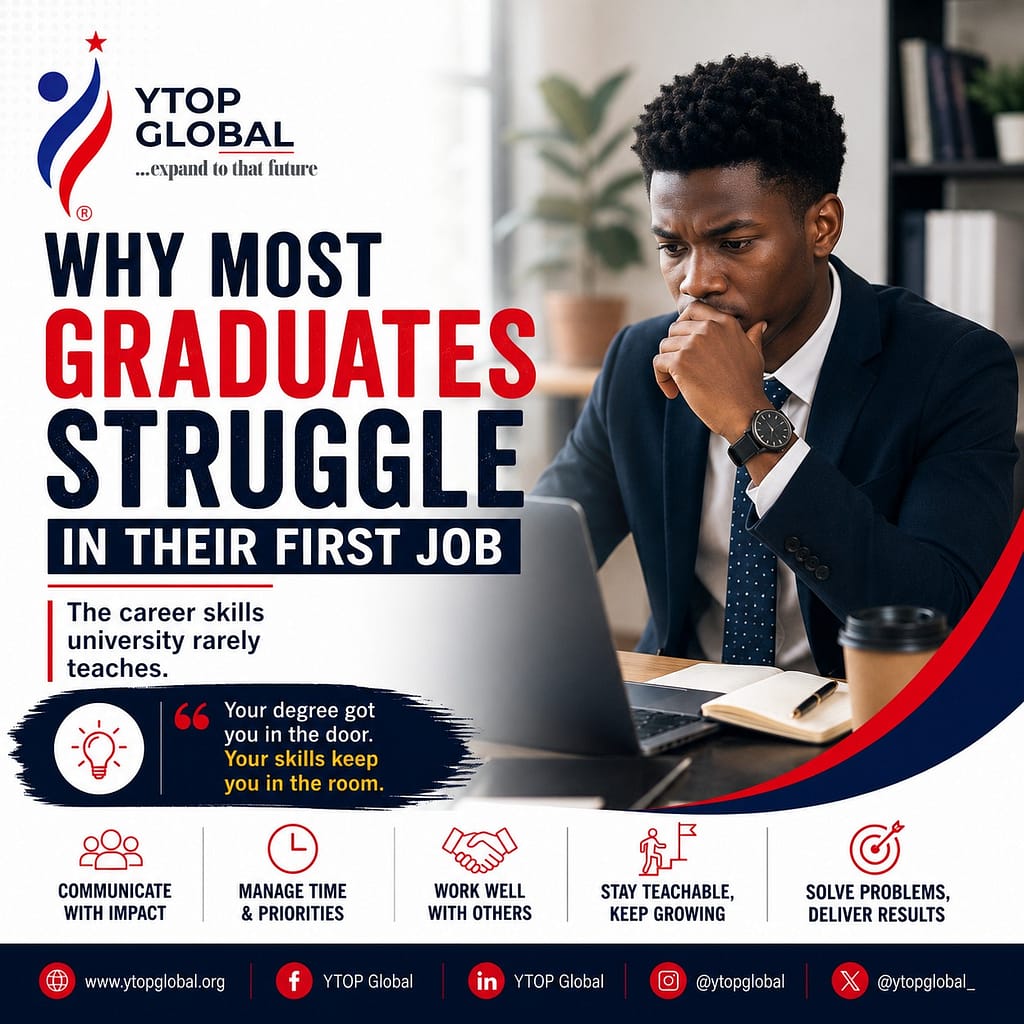
Knowledge opens the door.
Professional skills help you remain in the room.
Employers Want More Than Academic Excellence
Across industries, employers consistently say they value more than technical qualifications.
According to the World Economic Forum, employers increasingly seek skills such as problem-solving, communication, teamwork, adaptability, critical thinking, leadership, and emotional intelligence alongside technical expertise.
These skills are often called employability skills.
They determine how effectively someone works with others, responds to challenges, and contributes to an organisation.
A university degree may qualify you for an interview.
Your professional behaviour often determines whether you grow within the organisation.
A Story Many Nigerian Graduates Will Recognize
Imagine two graduates who begin work on the same day.
Both studied the same course.
Both graduated with similar grades.
The first graduate waits to be told exactly what to do.
They avoid asking questions because they fear looking inexperienced.
When mistakes happen, they blame circumstances.
The second graduate behaves differently.
They arrive early.
They take notes during meetings.
They ask thoughtful questions.
They accept corrections with humility.
They volunteer to help colleagues.
They actively look for ways to improve.
After one year, the second graduate receives greater responsibilities.
Many people assume it happened because they were more intelligent.
The truth is different.
They developed workplace habits that made them valuable.
The Biggest Shock Is Often Communication
Many graduates underestimate how important communication is.
Success at work is not only about what you know.
It is about how well you communicate what you know.
Can you explain your ideas clearly?
Can you write professional emails?
Can you present confidently?
Can you listen carefully before responding?
Can you communicate respectfully during disagreement?
Poor communication creates misunderstandings, delays projects, and weakens professional relationships.
Strong communication builds trust.
It is one of the fastest ways to become a valuable employee.
Feedback Is Not Failure
One difficult adjustment for many graduates is learning to receive feedback.
In school, criticism often affects grades.
At work, feedback is usually intended to improve performance.
Some young professionals become defensive.
Others lose confidence after small corrections.
Successful professionals think differently.
They understand that feedback is one of the fastest ways to grow.
Instead of asking,
“Why was I criticised?”
They ask,
“What can I learn from this?”
That simple shift changes everything.
No One Expects You to Know Everything
One common fear among new graduates is believing they must appear perfect.
They avoid asking questions because they worry people will think they are incompetent.
Ironically, employers often appreciate graduates who ask thoughtful questions.
Curiosity demonstrates a willingness to learn.
Pretending to know everything often creates bigger problems than admitting you need guidance.
Your first job is not an examination.
It is a learning environment.
The goal is progress, not perfection.
Professionalism Matters More Than You Think
Professionalism is often noticed before expertise.
Simple habits make a lasting impression.
Keeping your promises.
Meeting deadlines.
Being punctual.
Respecting colleagues.
Taking responsibility for mistakes.
Managing your emotions during difficult situations.
These behaviours may appear ordinary.
Yet they often separate dependable employees from everyone else.
Technical skills can usually be taught.
Character is much harder to teach.
The Workplace Rewards Problem Solvers
Many graduates wait for instructions.
The most valuable employees look for solutions.
Imagine your supervisor identifies a problem.
Instead of only pointing it out, you return with two possible solutions.
That approach immediately changes how people see you.
Organisations rarely reward people simply for identifying problems.
They reward people who help solve them.
Developing this mindset early in your career creates opportunities that qualifications alone cannot provide.
Keep Learning After You Get the Job
One mistake many graduates make is believing employment marks the end of personal development.
The opposite is true.
Your first job should become your second classroom.
Read books about your profession.
Take online courses.
Learn workplace technology.
Improve your writing.
Develop leadership skills.
Seek mentors.
Observe experienced colleagues.
Every new skill increases your value.
The graduates who continue learning often become tomorrow’s leaders.
Build Relationships, Not Just a Career
Success at work is rarely achieved alone.
Healthy professional relationships matter.
Treat colleagues with respect.
Support your team.
Listen more than you speak.
Celebrate other people’s success.
Build trust through consistency.
Networking is not merely collecting business cards.
It is building genuine relationships based on integrity and mutual respect.
Many career opportunities come through trusted relationships rather than public job advertisements.
Reflect on These Questions
Take a moment to ask yourself honestly.
If I started work tomorrow, what professional skill would challenge me the most?
Do I respond well to correction?
Am I investing in skills beyond my university degree?
What habits can I begin developing today that will make me a better professional tomorrow?
The answers may prepare you long before your first day at work.
Final Thoughts
Your first job may feel overwhelming.
You will make mistakes.
You will have questions.
You will experience moments of self-doubt.
That is normal.
Every experienced professional was once a beginner.
The graduates who grow the fastest are not those who know everything.
They are the ones who remain teachable.
Keep learning.
Accept feedback.
Communicate well.
Take responsibility.
Serve others with excellence.
Remember, your degree helped you enter the workplace.
Your attitude, character, and willingness to grow will determine how far you go.
At YTOP Global, we believe preparing young people for employment means more than helping them earn degrees. Through mentorship, leadership development, career readiness programmes, volunteer opportunities, and practical capacity-building, we equip young people with the workplace skills, confidence, and professional mindset needed to succeed in today’s rapidly changing world.
At YTOP Global, we believe young people deserve honesty, encouragement, and support, not pressure to figure life out overnight.