
Introduction
You finally find a job that matches your qualifications.
You spend hours completing the application.
You upload your CV.
You wait.
Days become weeks.
Nothing.
No interview.
No feedback.
No rejection email.
Just silence.
It is frustrating.
Many young people assume the problem is the job market.
Sometimes it is.
But in many cases, the problem is much simpler.
Your CV failed to convince the recruiter that you were worth interviewing.
The truth is that recruiters receive hundreds, sometimes thousands, of applications for a single vacancy.
They do not have time to read every CV from beginning to end.
Research from Ladders, Inc. found that recruiters spend only a few seconds on an initial review before deciding whether to continue reading.
That means your CV has one important job.
It must quickly answer one question.
“Why should we interview you?”
The good news is that writing a strong CV is a skill.
And like every skill, it can be learned.
Your CV Is a Marketing Document
Many graduates think a CV is simply a list of qualifications and previous jobs.
It is much more than that.
Your CV is a marketing document.
Its purpose is not to tell your life story.
Its purpose is to convince an employer that you can solve their problems.
Every section should answer one question.
How does this make me a stronger candidate?
If a piece of information does not help answer that question, it probably does not belong on your CV.
Recruiters Look for Value, Not Length
One of the biggest mistakes graduates make is believing that longer CVs look more impressive.
The opposite is often true.
Recruiters appreciate documents that are clear, relevant, and easy to read.
A well-organised two-page CV usually performs better than a five-page document filled with unnecessary details.
Focus on quality rather than quantity.
Every sentence should earn its place.
Start With a Strong Professional Summary
The top section of your CV matters.
It is often the first thing recruiters read.
Instead of writing a vague statement like,
“I am a hardworking graduate seeking employment.”
Write something specific.
For example,
“Recent Mechanical Engineering graduate with internship experience in manufacturing, strong analytical skills, and experience leading student engineering projects. Passionate about improving production efficiency and continuous learning.”
This immediately tells employers who you are and what you bring.
Show Results, Not Responsibilities
Many CVs describe duties.
Strong CVs describe achievements.
Instead of writing,
“Managed social media accounts.”
Write,
“Managed social media platforms, increasing audience engagement by 45% within six months.”
Instead of,
“Organised university events.”
Write,
“Led a team of 20 volunteers to organise a university conference attended by over 500 participants.”
Numbers make your experience more believable.
Employers remember measurable impact.
Experience Is More Than Employment
Many graduates worry because they have never worked full-time.
That does not mean you have no experience.
Include internships.
Volunteer work.
Leadership positions.
Academic projects.
Research.
Freelance work.
Professional certifications.
Community service.
Personal projects.
These experiences demonstrate responsibility, initiative, and practical skills.
Employers want evidence that you can apply what you know.
Tailor Every CV
One mistake destroys many applications.
Using the same CV for every job.
Different employers look for different skills.
Read the job description carefully.
Identify the skills the employer values.
Adjust your professional summary.
Highlight relevant achievements.
Reorder your skills.
Emphasise experiences that match the position.
A tailored CV shows that you understand the role.
Generic CVs often disappear unnoticed.
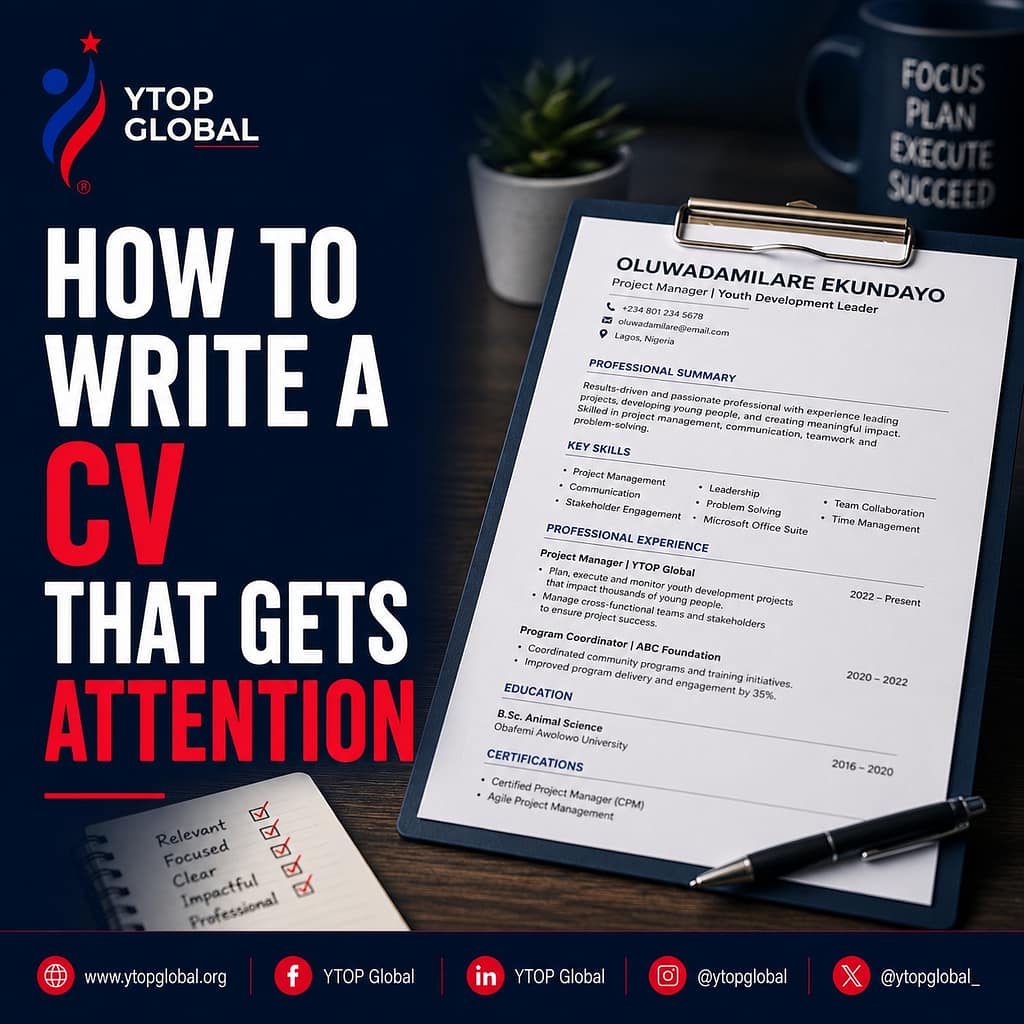
Make It Easy to Read
Recruiters should not struggle to find important information.
Use clear headings.
Consistent fonts.
Professional spacing.
Logical sections.
Avoid unnecessary colours or graphics unless you work in a creative industry.
Simple, clean formatting helps recruiters focus on your qualifications rather than your design choices.
Professional appearance creates a strong first impression.
Don’t Ignore Keywords
Many organisations now use Applicant Tracking Systems (ATS) to screen applications before a recruiter reads them.
These systems search for keywords that match the job description.
If a vacancy asks for project management, stakeholder engagement, Microsoft Excel, or customer service, and you genuinely possess those skills, include those exact terms naturally within your CV.
Do not copy the entire job description.
Instead, honestly reflect your experience using relevant language.
An ATS cannot recognise skills that are never mentioned.
Common CV Mistakes That Cost Interviews
Small mistakes create big problems.
Spelling errors.
Outdated contact information.
Unprofessional email addresses.
Poor formatting.
Long paragraphs.
False information.
Missing dates.
Irrelevant personal details.
Recruiters often view these mistakes as signs of poor attention to detail.
Before submitting your CV, review it carefully.
Better still, ask someone else to review it too.
Fresh eyes often notice mistakes you overlooked.
Your Online Presence Matters Too
Today, employers often search for candidates online.
Your LinkedIn profile should support your CV, not contradict it.
Keep your information consistent.
Use a professional photograph.
Share your learning journey.
Highlight achievements.
Build a positive digital reputation.
Your personal brand now extends beyond your CV.
Keep Improving Your CV
Your CV is not a document you write once and forget.
Update it regularly.
Add new achievements.
Include certifications.
Document measurable results.
Record volunteer work.
Track leadership experiences.
The strongest CVs evolve alongside your career.
Reflect on These Questions
Take a moment to ask yourself.
Does my CV clearly show the value I bring?
Have I described achievements instead of responsibilities?
Have I tailored my CV for the job I am applying for?
Would I invite myself for an interview after reading my CV?
Honest answers can improve your next application.
Final Thoughts
A CV does not get you a job.
It gets you an interview.
That is its purpose.
A strong CV tells a clear story.
It shows what you have done.
What you have learned.
The value you can create.
It helps employers imagine you contributing to their organisation.
Remember, recruiters are not looking for perfect candidates.
They are looking for people who demonstrate potential, professionalism, and evidence of growth.
Invest time in writing a CV that reflects your best work.
It may become one of the most valuable documents you ever create.
At YTOP Global, we believe every young person deserves the opportunity to compete confidently in today’s job market. Through career development programmes, CV writing workshops, mentorship, leadership training, and employability initiatives, we help young people present themselves professionally and prepare for meaningful careers.
At YTOP Global, we believe young people deserve honesty, encouragement, and support, not pressure to figure life out overnight.