Introduction
Walk into a thriving community and you will notice something interesting.
People know one another.
Volunteers are active.
Local projects continue to grow.
Young people organise events.
Businesses support community initiatives.
Leaders work together.
Problems are discussed openly.
Solutions are created collectively.
Now compare that with a struggling community.
People feel disconnected.
Public spaces are neglected.
Community projects disappear.
Young people lose interest.
Everyone waits for someone else to take responsibility.
The difference is rarely money alone.
More often, it is participation.
Communities become stronger when people contribute instead of simply observing.
Young people play an especially important role because they bring energy, creativity, new ideas, and a willingness to challenge old ways of thinking.
The truth is simple.
Communities grow when young people stop asking, “What has my community done for me?” and start asking, “What can I do for my community?”
Communities Need More Than Leaders
Many people believe communities improve only because of elected officials.
Leadership certainly matters.
But healthy communities are built by ordinary people making extraordinary contributions.
Teachers.
Volunteers.
Entrepreneurs.
Students.
Health workers.
Farmers.
Faith leaders.
Young people.
Every person has something valuable to contribute.
A strong community is everyone’s responsibility.
A Story Many Young People Will Recognize
Imagine two neighbouring communities.
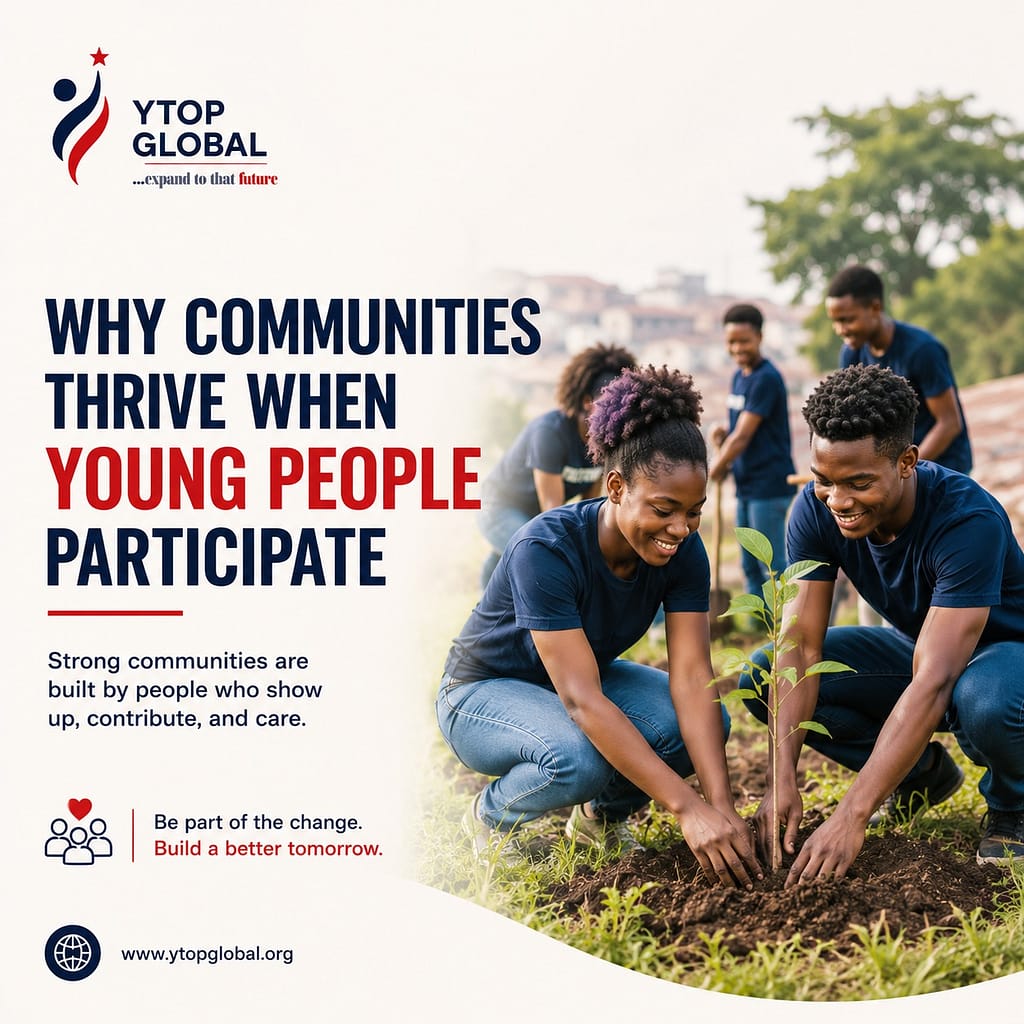
In one community, young people spend their weekends organising environmental clean-up projects, mentoring children, supporting local businesses, and volunteering during health campaigns.
In the other, young people believe community development is someone else’s responsibility.
Five years later, the difference is obvious.
The first community has cleaner streets, stronger relationships, more youth programmes, and greater civic participation.
The second continues to struggle with problems that nobody takes ownership of.
Communities reflect the participation of their people.
Young People Bring New Ideas
Every generation sees the world differently.
Young people understand technology.
Digital communication.
Social media.
Innovation.
Creative problem-solving.
These strengths can help communities respond to modern challenges.
Fresh ideas often improve long-standing systems.
Communities become stronger when they welcome youthful perspectives instead of dismissing them.
Experience and innovation work best together.
Participation Builds Responsibility
When you become involved in your community, something changes.
Problems become personal.
Solutions become meaningful.
You begin caring more deeply about your environment.
You understand local challenges better.
You become more accountable.
Participation transforms observers into stakeholders.
People protect what they help build.
Community Service Strengthens Leadership
Leadership develops through practice.
Every community project teaches valuable lessons.
Planning.
Communication.
Teamwork.
Conflict resolution.
Time management.
Problem-solving.
Decision-making.
These experiences prepare young people for future careers while improving their communities today.
Service is leadership in action.
Strong Communities Support Strong Economies
Community participation does more than improve relationships.
It also supports economic growth.
Local businesses grow when communities support them.
Youth entrepreneurship creates employment.
Volunteer programmes strengthen education.
Healthy communities attract investment.
When people work together, opportunities increase.
Community development and economic development often grow side by side.
Young People Inspire Other Young People
Positive action spreads.
When one young person starts mentoring children, others often join.
When someone organises a community project, more volunteers appear.
When one person demonstrates leadership, others gain confidence.
Influence grows through example.
Communities improve because ordinary people choose to lead through action.
Collaboration Creates Lasting Impact
The biggest community challenges cannot be solved alone.
Schools need parents.
Youth groups need local businesses.
Nonprofits need volunteers.
Communities need partnerships.
Young people who learn to collaborate become more effective changemakers.
Lasting impact is rarely created by individuals working alone.
It grows through shared purpose.
Active Citizenship Matters
Healthy communities need active citizens.
People who vote responsibly.
Volunteer regularly.
Respect public spaces.
Support local initiatives.
Help neighbours.
Participate in community discussions.
Young people who develop these habits early often become responsible leaders later in life.
Communities thrive when participation becomes a culture.
Faith Calls Us to Seek the Good of Others
The Bible teaches that we should care about the communities where we live.
In Jeremiah 29:7, God instructed His people,
“Seek the peace and prosperity of the city to which I have carried you.”
This reminds us that faith is not only personal.
It also has a community dimension.
Serving others.
Supporting local development.
Promoting peace.
Helping those in need.
These are practical ways we live out our values.
Communities become healthier when people choose service over selfishness.
Reflect on These Questions
Take a few moments to think honestly.
What positive contribution have I made to my community this year?
If every young person behaved like me, would my community become stronger?
What skills could I use to help solve a local problem?
Which community initiative could I support this month?
Every community changes because someone decides to participate.
Final Thoughts
Communities do not become stronger by accident.
They become stronger because people care enough to contribute.
Young people are not only the future of their communities.
They are part of their present.
Your ideas matter.
Your skills matter.
Your time matters.
Your service matters.
Do not wait until someone invites you to make a difference.
Look around.
Find a need.
Offer your skills.
Build relationships.
Work with others.
Small acts of participation create stronger communities for everyone.
At YTOP Global, we believe community transformation begins when young people become active participants instead of passive observers. Through leadership development, volunteer programmes, mentorship, community projects, and youth empowerment initiatives, we equip young people to contribute meaningfully, strengthen their communities, and create lasting social impact.
At YTOP Global, we believe thriving communities are built by young people who choose to participate, serve, and lead with purpose.