
Introduction
One of the questions young people ask more than almost any other is this.
“What do I want to become?”
It sounds like a simple question.
But for many people, it feels overwhelming.
Some of your friends already seem to know exactly what they want.
One wants to become a doctor.
Another is building a technology startup.
Someone else is studying abroad.
Meanwhile, you are still trying to figure things out.
The more you compare yourself to others, the more confused you become.
You begin wondering if something is wrong with you.
There isn’t.
The truth is that many successful people did not have their lives completely planned in their twenties.
Some changed careers.
Some discovered new passions after graduation.
Others found opportunities they never expected.
The important thing is not having every answer today.
It is making progress with what you know today.
You do not need perfect clarity before taking your next step.
Career Confusion Is More Common Than You Think
Social media creates the impression that everyone has life figured out.
People post promotions.
Business launches.
Scholarships.
Graduation photos.
Dream jobs.
What you rarely see are the months of uncertainty.
The failed applications.
The rejected interviews.
The career changes.
The mistakes.
Many young people quietly struggle with uncertainty while pretending to be confident.
Feeling uncertain about your future does not mean you are behind.
It means you are human.
Why So Many Young People Feel Lost
There are many reasons career confusion has become more common.
The world changes faster than ever before.
New careers appear every year.
Artificial intelligence is transforming industries.
Traditional career paths are changing.
Families often expect young people to follow certain professions.
Friends influence decisions.
Social media creates unrealistic expectations.
Instead of choosing based on purpose, many people choose based on pressure.
That rarely leads to fulfilment.
A Story Many Young People Will Recognize
Imagine a university graduate who studied accounting because everyone said it was a secure career.
After graduation, they find themselves more interested in digital marketing and communication.
They feel guilty.
They wonder if changing direction means they failed.
It doesn’t.
Or consider someone who graduates without knowing what career they truly enjoy.
Instead of exploring different opportunities, they become paralysed because they fear making the wrong decision.
Months become years.
The greatest mistake is not choosing the wrong career.
The greatest mistake is refusing to move because you are waiting for perfect certainty.
You Discover Your Path by Walking It
Many people believe clarity comes before action.
Life often works differently.
Clarity usually comes after action.
You learn what you enjoy by trying different things.
You discover your strengths by solving real problems.
You identify your interests through experience.
Volunteering.
Internships.
Part-time work.
Leadership opportunities.
Community service.
Side projects.
Each experience teaches you something about yourself.
Waiting for complete certainty often delays growth.
Movement creates clarity.
Stop Comparing Your Journey
Comparison is one of the fastest ways to lose confidence.
Your friend may become successful at twenty-four.
Someone else may discover their purpose at thirty-five.
Another person may change careers at forty.
Life is not a competition.
Everyone begins from different circumstances.
Different opportunities.
Different challenges.
Different timelines.
Success is not about arriving first.
It is about becoming the person you were created to become.
Focus on your own journey.
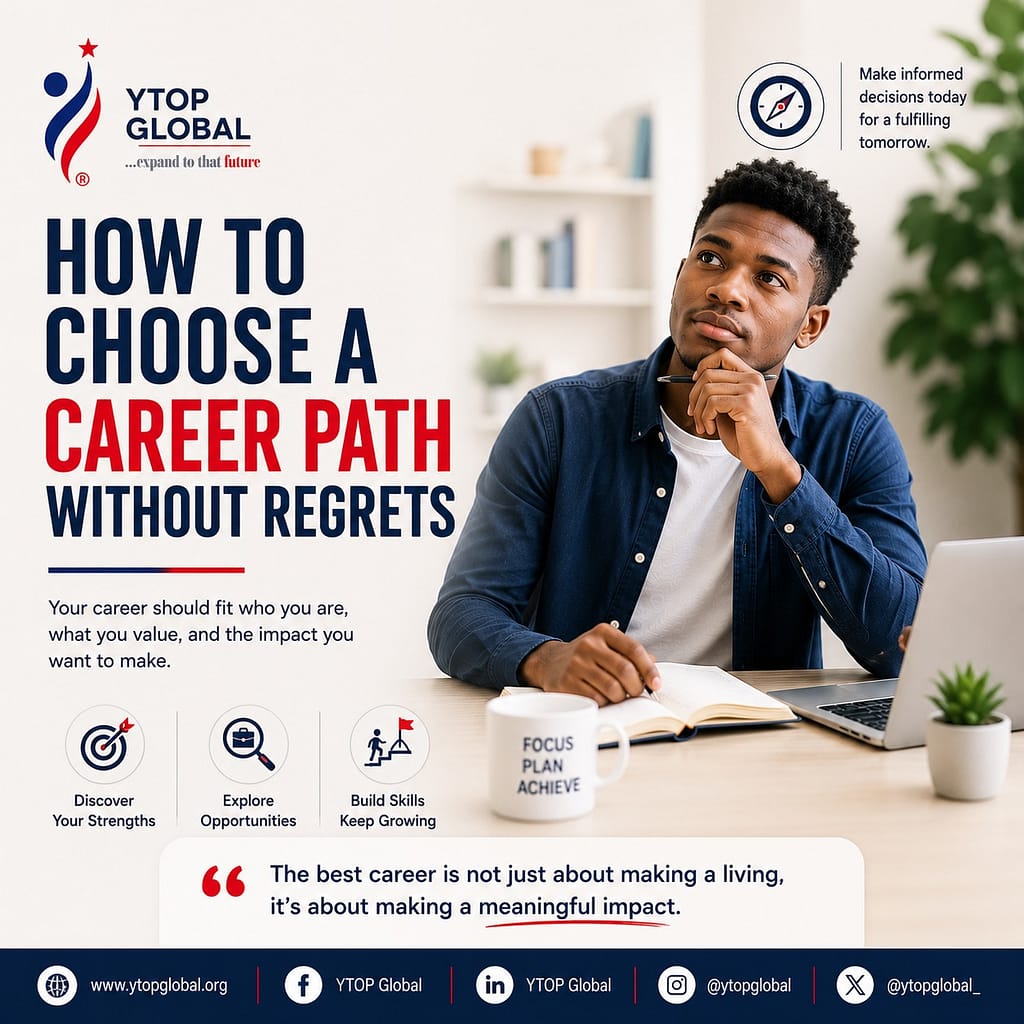
Your First Career Does Not Have to Be Your Last
Many people feel enormous pressure to choose one career that will define the rest of their lives.
That pressure is unnecessary.
According to the World Economic Forum, technological change continues to reshape the global workforce, requiring people to learn new skills and adapt throughout their careers.
Many professionals change industries.
Learn new skills.
Start businesses.
Return to school.
Move into leadership.
Your first job is often the beginning of your career story, not the final chapter.
Stay open to growth.
Know Yourself Before Choosing a Career
Instead of asking only,
“What career pays the most?”
Ask better questions.
What problems do I enjoy solving?
What work gives me energy?
What skills come naturally to me?
What kind of environment helps me do my best work?
What impact do I want my life to have?
The better you understand yourself, the better your career decisions become.
Purpose begins with self-awareness.
Seek Wise Guidance
You do not have to figure everything out alone.
Talk to mentors.
Lecturers.
Professionals.
Career advisers.
People working in fields that interest you.
Ask questions.
Listen carefully.
Learn from their experiences.
A single conversation can provide direction that saves years of confusion.
That is one reason mentorship is so valuable.
Experience shortens the learning curve.
Keep Learning While You Wait
One mistake many young people make is stopping personal development while waiting for clarity.
Do not wait.
Read books.
Take online courses.
Volunteer.
Develop digital skills.
Improve your communication.
Learn project management.
Strengthen your leadership.
Every new skill increases your opportunities.
Growth rarely goes to waste.
Even if your direction changes later, the skills you develop today will continue serving you.
Faith Can Provide Direction
For many young people, career confusion is not only practical.
It is spiritual.
You may wonder whether God has a specific purpose for your life.
The Bible reminds us that God is interested in guiding those who seek Him.
Solomon wrote in Proverbs 3:5-6,
“Trust in the Lord with all your heart and lean not on your own understanding; in all your ways submit to Him, and He will make your paths straight.”
Seeking God’s direction does not mean you will receive every answer immediately.
It means you can move forward with confidence, trusting that He is guiding your steps even when the full picture is not yet visible.
Faith does not remove uncertainty.
It provides peace while you continue moving.
Reflect on These Questions
Take a quiet moment to ask yourself.
What activities make me lose track of time?
What problems do I genuinely enjoy solving?
Am I making career decisions because of purpose or because of pressure?
What small step can I take this month to explore a possible career path?
Sometimes the next step is all you need to discover the one after it.
Final Thoughts
Not knowing exactly what you want to become is not a sign of failure.
It is often part of the journey.
The people who eventually find meaningful careers are rarely those who had every answer from the beginning.
They are the people who remained curious.
Who kept learning.
Who explored opportunities.
Who sought guidance.
Who trusted God.
Who continued moving forward even when the future felt uncertain.
Do not allow confusion to stop your growth.
Your future is not built in one decision.
It is built through many small decisions made consistently over time.
Keep learning.
Keep serving.
Keep exploring.
Your purpose is often discovered while you are faithfully taking the next step.
At YTOP Global, we believe every young person deserves guidance while navigating life’s biggest decisions. Through mentorship, leadership development, career readiness programmes, volunteer opportunities, and youth empowerment initiatives, we help young people discover their strengths, develop practical skills, and build the confidence to pursue meaningful careers and purposeful lives.
At YTOP Global, we believe young people deserve honesty, encouragement, and support, not pressure to figure life out overnight.