
Introduction
A few decades ago, creating social impact was often left to governments, large charities, and wealthy philanthropists.
Today, that is changing.
A university student can raise funds online for a community project.
A young software developer can build an app that connects people with healthcare.
A volunteer can start a movement on social media that inspires thousands of people to take action.
A small youth organization can influence policies, educate communities, and transform lives.
Young people are no longer waiting for permission to make a difference.
They are becoming the difference.
The future of social impact will not be led only by institutions.
It will be driven by young people who are willing to solve problems with creativity, technology, collaboration, and compassion.
The question is no longer whether young people can create change.
The real question is whether enough young people are preparing themselves to lead that change.
A New Generation of Problem Solvers
Every generation faces challenges.
Today’s young people face unemployment.
Climate change.
Mental health concerns.
Food insecurity.
Digital inequality.
Poor access to quality education.
Healthcare challenges.
These problems are real.
But so are the opportunities.
Unlike previous generations, today’s youth have access to technology, knowledge, and global networks that make solving problems more possible than ever before.
A single idea can now reach millions of people within days.
That creates enormous responsibility.
A Story Many Young People Will Recognize
Imagine a young graduate who notices that students in rural communities lack access to career guidance.
Instead of simply discussing the problem, they organise free online mentoring sessions every weekend.
A few volunteers join.
The programme expands.
Schools begin partnering with the initiative.
Within a few years, thousands of young people have received guidance that changes their future.
Nothing extraordinary happened at the beginning.
One person simply decided to start.
That is how many impactful organizations begin.
Technology Has Changed Social Impact
Technology has transformed how communities solve problems.
Young people now use digital platforms to educate.
Raise funds.
Recruit volunteers.
Deliver healthcare.
Teach skills.
Support farmers.
Promote environmental sustainability.
Artificial intelligence.
Mobile applications.
Online learning.
Digital payments.
Remote collaboration.
These tools allow even small organizations to create significant impact.
Technology does not replace compassion.
It multiplies it.
Collaboration Will Matter More Than Competition
Many social problems are too complex for one organization to solve alone.
The future belongs to partnerships.
Youth organizations working with governments.
Businesses supporting nonprofits.
Universities collaborating with communities.
Professionals mentoring students.
Communities working together across sectors.
The strongest social impact initiatives will be built through collaboration instead of competition.
Real change happens when people unite around a shared purpose.
Leadership Will Look Different
Future leaders will need more than technical knowledge.
They will need empathy.
Adaptability.
Cultural awareness.
Communication.
Critical thinking.
Integrity.
The ability to bring people together.
Leadership is becoming less about authority and more about influence.
Young people who learn to serve, listen, and collaborate will be better prepared for the future.
Young People Must Develop Practical Skills
Passion is important.
But passion without skills rarely creates lasting impact.
Future changemakers need practical abilities.
Project management.
Fundraising.
Public speaking.
Financial management.
Digital communication.
Research.
Data collection.
Monitoring and evaluation.
Community engagement.
These skills help transform good intentions into measurable results.
Impact grows when passion meets competence.
Every Community Needs Local Solutions
Many of the world’s biggest challenges require local action.
Young people understand the realities of their own communities.
They know the needs.
The culture.
The opportunities.
This gives them an important advantage.
Local solutions designed by local people often create stronger and more sustainable results than ideas imposed from outside.
Communities grow stronger when young people become active contributors rather than passive observers.
The Future Belongs to Lifelong Learners
The world is changing rapidly.
Technology evolves.
Communities change.
New challenges emerge.
Successful changemakers will continue learning throughout their lives.
According to the World Economic Forum, continuous learning, creativity, resilience, analytical thinking, and leadership remain among the most important capabilities for the future workforce.
The same qualities will shape the future of social impact.
Learning is no longer optional.
It is essential.
Faith Reminds Us That Every Generation Has a Purpose
Throughout Scripture, God has consistently worked through young people.
Young David stepped forward when others were afraid.
Young Esther used her position to protect her people.
Young Timothy became a respected leader because he remained faithful despite his age.
These stories remind us that age has never been God’s greatest requirement.
Availability has.
Every generation receives opportunities to make a difference.
This generation is no exception.
Reflect on These Questions
Take a few moments to think honestly.
What problem in my community concerns me the most?
What skills do I need to create meaningful impact?
Who could I partner with to solve a problem bigger than myself?
If I started today, whose life could become better because I chose to act?
The future is shaped by people who ask these questions and respond with action.
Final Thoughts
The future of social impact will not belong only to governments or international organisations.
It will belong to young people who choose to solve problems instead of only discussing them.
Young people who continue learning.
Who work together.
Who lead with integrity.
Who embrace technology responsibly.
Who care enough to act.
You do not have to wait until you become older.
Or richer.
Or more influential.
You can begin where you are.
With what you know.
Using what you have.
The next generation of changemakers is already emerging.
The question is whether you will be one of them.
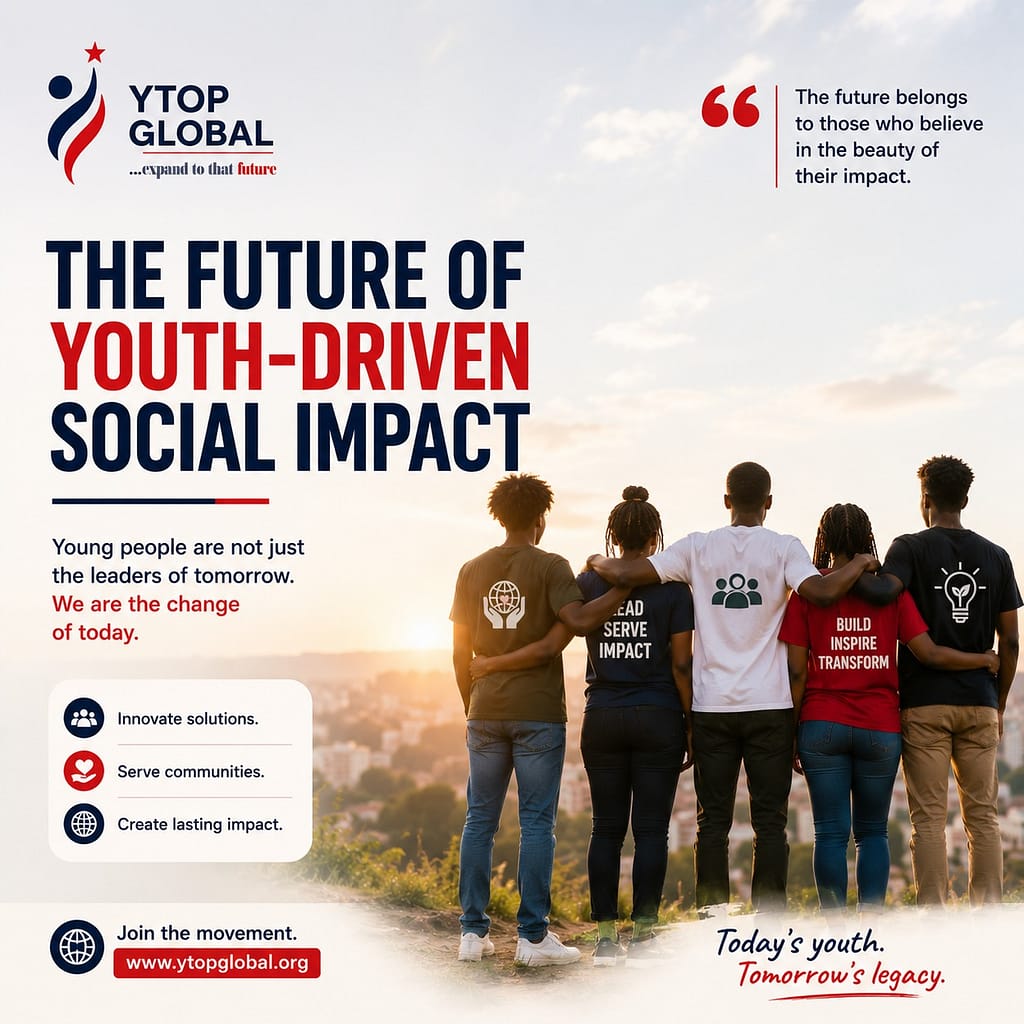
At YTOP Global, we are preparing young people to become the leaders, innovators, volunteers, and changemakers who will shape Africa’s future. Through leadership development, mentorship, community projects, volunteer programmes, career readiness training, and practical learning experiences, we help young people turn ideas into action and passion into measurable impact.
At YTOP Global, we believe the future of social impact begins with young people who are willing to serve today for a better tomorrow.