
Introduction
Every community has needs.
Some need better schools.
Others need cleaner environments.
Some struggle with unemployment.
Others face poor healthcare, insecurity, or limited opportunities for young people.
When these challenges appear, many people ask,
“Who will fix this?”
Few ask,
“What role can I play?”
That question makes all the difference.
Community development is often viewed as the responsibility of governments, community leaders, or nonprofit organisations.
While these groups play important roles, lasting development happens when ordinary citizens become active participants.
Young people are especially important.
They bring energy.
New ideas.
Creativity.
Technology.
A willingness to try different approaches.
Communities that involve young people are often more innovative, resilient, and prepared for the future.
Community development is not something young people should wait to inherit. It is something they should help build today.
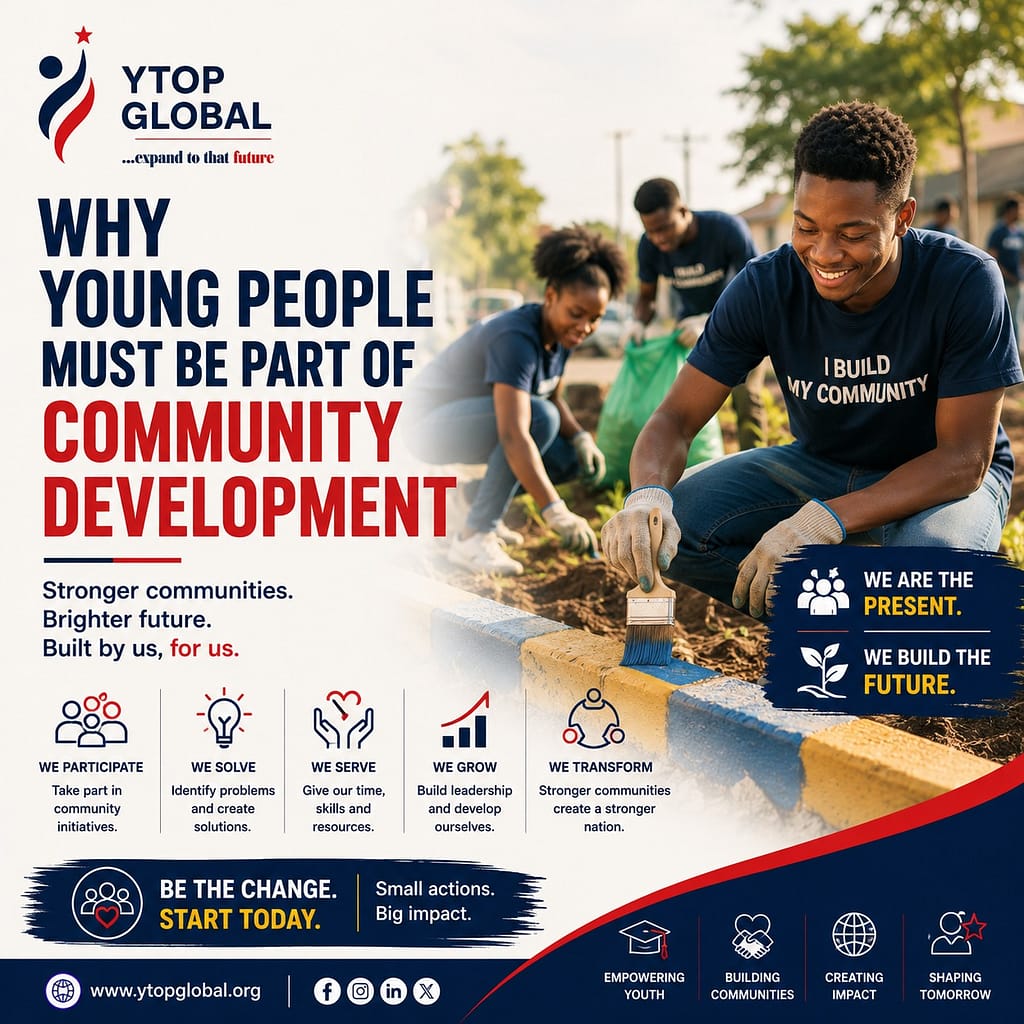
Communities Reflect the People Who Live in Them
Every community tells a story.
Clean streets.
Active schools.
Safe neighbourhoods.
Growing businesses.
Supportive relationships.
These things do not happen by accident.
They happen because people choose to contribute.
Likewise, communities decline when everyone waits for someone else to act.
Development begins when responsibility becomes shared.
A Story Many Young People Will Recognize
Imagine two communities with similar challenges.
In one, young people spend their free time organising reading clubs, supporting local businesses, mentoring school children, and participating in environmental projects.
In the other, young people believe development is someone else’s responsibility.
Five years later, the difference becomes clear.
The first community has stronger youth programmes, cleaner public spaces, and more opportunities.
The second continues facing the same problems.
The difference was participation.
Not potential.
Young People Understand Today’s Challenges
Every generation experiences different realities.
Today’s young people understand digital technology.
Social media.
Mental health.
Modern education.
Innovation.
Entrepreneurship.
These perspectives help communities respond to changing needs.
Communities become stronger when young voices are heard and respected.
Service Builds Better Leaders
Community development is one of the best leadership classrooms.
Young people learn how to communicate.
Work in teams.
Manage projects.
Solve problems.
Resolve conflicts.
Build partnerships.
These experiences prepare them for future careers while improving their communities today.
Leadership grows through service.
Small Contributions Create Lasting Impact
Many young people believe they need significant funding before making a difference.
That is rarely true.
Helping children with homework.
Organising a neighbourhood clean-up.
Supporting local farmers.
Teaching digital skills.
Visiting elderly people.
Promoting environmental awareness.
These actions may appear small.
Together, they strengthen communities.
Progress grows through consistency.
Community Development Creates Opportunities
Healthy communities create better opportunities for everyone.
Businesses grow.
Education improves.
Crime decreases.
Public health becomes stronger.
Young people find more opportunities to learn, work, and lead.
Community development is not charity.
It is an investment in everyone’s future.
Collaboration Makes Communities Stronger
No individual can solve every challenge.
Communities grow when people work together.
Youth groups.
Schools.
Faith organisations.
Businesses.
Community leaders.
Local governments.
Each has a role to play.
Collaboration creates stronger and more sustainable solutions.
Active Citizens Build Better Nations
Community development is the foundation of national development.
A nation is only as strong as its communities.
When young people actively improve their neighbourhoods, they also contribute to the future of their country.
Nation building begins locally.
Positive change spreads from one community to another.
Faith Calls Us to Care for Our Neighbours
Jesus taught that loving our neighbours requires action.
In Luke 10, He told the story of the Good Samaritan, who did not ignore someone in need.
He stopped.
Helped.
Served.
That example reminds us that faith is demonstrated through compassion and responsibility.
Serving your community is one practical way to love your neighbour.
Reflect on These Questions
Take a few moments to think honestly.
What challenge in my community concerns me most?
What skill could I use to help address that challenge?
Am I contributing to my community or simply observing it?
Who could I work with to create greater impact?
Every stronger community begins with people willing to participate.
Final Thoughts
Communities do not improve because people hope they will.
They improve because people take responsibility.
Young people have the ideas.
The energy.
The creativity.
The ability to inspire others.
Do not underestimate your contribution.
Volunteer.
Mentor.
Organise.
Support.
Lead.
The future of your community depends on people who are willing to act today.
At YTOP Global, we believe community transformation begins with active young people. Through leadership development, mentorship, volunteer programmes, community projects, and youth empowerment initiatives, we equip young people to become responsible citizens who create practical solutions and lasting impact where they live.
At YTOP Global, we believe every young person has the ability to strengthen their community through service, leadership, and action.